Showing posts with label Student Leaders. Show all posts

Tuesday, September 20, 2016

A new generation.


Psalm 145 has been following me around for the last 5 months or so, ever since I served in the Small Group Leaders' Track at Basileia this past May.  The repetition isn't anything to groan about, though -there is lots of good stuff to meditate upon that's readily applicable to ministry on campus, especially as we try to meet as many new RIT students as possible on campus.  Here are some themes I've noticed from this psalm:

There's a challenge to me personally.  "I will extol you, my God and King, and bless your name forever and ever..." --Psalm 145:1

The Psalm doesn't start with David telling God what He should do, or telling the people what they should do.  It starts (and ends!) with David's personal ownership, commitment, and responsibility to give praise to God.  As a leader, before I give out direction or instruction, I must examine the extent of my own commitment and responsibility to praise God for who He is.   

There's a challenge to my students.  "One generation shall commend your works to another, and shall declare your mighty acts..." --Psalm 145:4

If we look around at this generation of college students, the next generation of leaders, business men and women, researchers, marketers, scientists, technologists, etc., is it true that this generation is passing on and declaring what God has done?  Is this something my students long for and work towards?  If not, then why not?

There's a challenge to respond out of God's character.  "The LORD is gracious and merciful, slow to anger and abounding in steadfast love..." --Psalm 145:8

All throughout this psalm is declaration after declaration of who God is and what His character is like.  Everything the author writes is in the context of God's grace, mercy, goodness, greatness, faithfulness, etc.  We praise Him because of His greatness and His great works.  We invest in the next generation because of God's mightiness.  What an encouragement!  My students and I can praise His name not because of what we've done or left undone, but because of what God has done and who He is.

May God continue to be faithful despite our lack of faith.  May we continue to declare His graciousness even in the midst of craziness of this season of ministry.  Amen.

Thursday, July 30, 2015

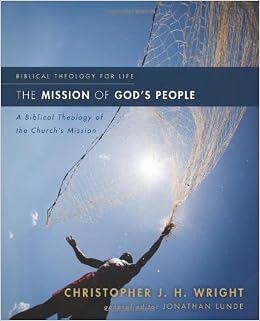
Leaders are Readers: The Mission of God's People

Harry S. Truman said, "Not all readers are leaders, but all leaders are readers."  This 'Leaders are Readers' series highlights books I read and my reflections on them to bolster my leadership learning as I serve students on campus.

Today's book is:  The Mission of God's People - by Christopher J. H. Wright

There was one thought that kept floating through my mind every time I picked up this book to read another section:  I wish my students would read this.

It would give great fodder for conversation around what the mission of God's people is, why we exist as an IV group on campus, and how those two things collide.

It was a great reminder of who we are called to be as God's people, and gave me a more thorough biblical look at our mission, beyond what I was taught in Sunday School as a kid.

Plus, as you read it you'd come across these great nuggets of truth that were packed with punch.  Like this one:

"When a whole community was called to know God, as Old Testament Israel was, it was a comprehensive social agenda, not just a badge of nominal national religion" (pg 151).

Wa-pow!

Here are some questions I'm reflecting on now that I've finished the read:
1) What would our InterVarsity chapter look like if students served and led from a place of God's mission as God's people, and not out of obligation, guilt, or fear?

2) How can I use the content and framework of this book to communicate the mission of God's people to my students?

Why I'd recommend it to you:
1) It's an academic read, but it doesn't read like an academic read.  It feels more conversational and logical as opposed to intellectual and stuffy.

2) I thought the sections gave helpful reflection questions for both individuals and groups.

3) It is thorough.  And I mean thorough.  It definitely feels like a textbook you would give out to a seminary class.

4) It gives a full, biblical exploration of the mission of God's people, not just the New Testament or one passage in the Bible.

What I'd be aware of:
1) It has TONS of side quotes and such.  I found them to be distracting although once in a while enlightening.  I skipped most of them because I hate having to read the main content and then go back to the side quotes or vice versa.


2) It took me a long time to finish reading.  Now granted, I'm a slow reader to begin with.  But, it confused me as to why it took me so long when it was a relatively easy read.  I definitely had a little celebration party for myself when I finally finished it.  Just a potential warning, I guess.

Tuesday, July 21, 2015

Post-Basileia Story: The gift of an image

It's been another hard year, but Basileia was so good and refreshing that I nearly forgot all about how hard it was.

One of the reasons is because of a significant moment for me during chapter time.  While I had been leading these sessions earlier in the week, I decided to step back and give control over to the new Servant Leadership Team (SLT, student exec board) to get some practice.  So I kept my mouth shut as much as I could and let them run with their ideas.  They started off by posing the question, "What does vision mean?" to the group for discussion.  Then Marian spoke up.

"Well, I like to think of vision as a picture of an island," she said, in her usual light-hearted manner.  She went on to explain how we are standing on an island, looking out and seeing another island across the water, and how it looks so beautiful and wonderful that we just can't stay on this island any longer - we must get in a boat and go to that other island.  Vision is the picture of getting to that other, better island.
via Unsplash
To you, it may seem silly or insignificant, but let me tell you a little bit about who Marian is.  Marian was one of the very first students I started working with when I switched campuses to RIT.  My official capacity began at Basileia the year Marian was one of my new student leaders.  It was a crazy year of learning about the campus culture and learning how to lead in the midst of that learning.

One of the ways I led was by teaching the new team what vision was and how it described the current state of the chapter.  The image I used was that of an island.  I said that some students were in the boat, ready to go to that wonderful island but just didn't know how, and some students were back on the shore, confused about why we needed to leave this perfectly good island in the first place.  I often exhorted the SLT to lead other students in such a way that invites more students to come on board the boat, and invites the students who are already on board to have greater clarity around the direction in which we're going.

It was such a distinct image for me that I even journaled about it.

So hearing Marian share about this image was a rattling moment for me in bringing the past 3 years of staff to the present.  It was a moment of experiencing God's presence, with Him saying, "I have been and still am doing a good work in you and through you."  It was a concrete, tangible way to hold on to Jesus in a time where not many of those moments come around.

What a gift from the Lord!

Friday, January 30, 2015

Weeping for RIT.

My Servant Leaders (the student exec team) and I have taken on the practice of spending 15 minutes of our weekly meeting to study and discuss a Bible passage.

As you can imagine, 15 minutes is not a lot of time to study a Bible passage.

To combat that a little bit, I've asked the leadership team to spend the entire week prior to the meeting in that passage during their quiet times with Jesus.  They can study it however they want.  They're encouraged to pray through whatever comes to the surface for them.  They're expected to come to our meeting having spent much more time with this Word on their own than we're able to do so together, armed and ready to share what came up for them during the week.

We're going through the book of Nehemiah, and this past week we went over the first chapter, where Nehemiah hears about the tragic state of condition of Jerusalem and Judah:  "The remnant there in the province who had survived the exile is in great trouble and shame.  The wall of Jerusalem is broken down, and its gates are destroyed by fire" (Nehemiah 1:3, ESV).


Like I said, 15 minutes is not a lot of time to study the many layers of scripture we could unpack.

So we focused on one point - how Nehemiah responded to the news.  Here's what we found:

He immediately wept and mourned for days.  Nehemiah must have cared deeply enough about Jerusalem and his people that it brought such grief into his heart, as one would if someone very close and dear to them had passed away.

He fasted and prayed.  Nehemiah is brought to his knees, but not only that, he does not pray a prayer of, "Please help and deliver them, Lord!" or, "Why must my people go through this suffering?".  Instead, he interestingly prays a prayer of confession.

He identifies with the good and the bad of his people.  Not only does Nehemiah pray a prayer of confession (weird), but he identifies with his people in their sins!  "We have sinned against you," Nehemiah 1:6b says.  "Even I and my father's house have sinned."  He doesn't try to put the blame on anyone else.  He doesn't distance himself from his confession; even though he seems like he has the right not to involve himself.

He wasn't physically there.  This was in response to news that someone had brought to him from afar - he hadn't even seen the state of his community with his own eyes.  Either Nehemiah was super touchy-feely and sensitive, or he cared so deeply and identified so deeply with his community that he was moved deeply by this tragic news, even though he was miles away from the desolation itself.   

As we discussed these observations in our mere few minutes, one question kept coming to mind:

Why don't we respond to the brokenness on RIT's campus the way Nehemiah responds to Jerusalem's brokenness? 

It was a question I posed to the Servant Leadership team.  I asked them to imagine if they had gotten some news from someone during the winter break that RIT's campus was in shambles, would they react the way Nehemiah did, in weeping and mourning and praying prayers of confession on behalf of the sins we as a community committed?  Definitely not, we all agreed, myself included.

But why not? I wonder.  And what would it take for us to get to a point where we did identify and care so deeply with the RIT community that we wouldn't hesitate to respond to and lead out of the spiritual shambles we face everyday?