Showing posts with label Reading. Show all posts

Tuesday, September 20, 2016

A new generation.


Psalm 145 has been following me around for the last 5 months or so, ever since I served in the Small Group Leaders' Track at Basileia this past May.  The repetition isn't anything to groan about, though -there is lots of good stuff to meditate upon that's readily applicable to ministry on campus, especially as we try to meet as many new RIT students as possible on campus.  Here are some themes I've noticed from this psalm:

There's a challenge to me personally.  "I will extol you, my God and King, and bless your name forever and ever..." --Psalm 145:1

The Psalm doesn't start with David telling God what He should do, or telling the people what they should do.  It starts (and ends!) with David's personal ownership, commitment, and responsibility to give praise to God.  As a leader, before I give out direction or instruction, I must examine the extent of my own commitment and responsibility to praise God for who He is.   

There's a challenge to my students.  "One generation shall commend your works to another, and shall declare your mighty acts..." --Psalm 145:4

If we look around at this generation of college students, the next generation of leaders, business men and women, researchers, marketers, scientists, technologists, etc., is it true that this generation is passing on and declaring what God has done?  Is this something my students long for and work towards?  If not, then why not?

There's a challenge to respond out of God's character.  "The LORD is gracious and merciful, slow to anger and abounding in steadfast love..." --Psalm 145:8

All throughout this psalm is declaration after declaration of who God is and what His character is like.  Everything the author writes is in the context of God's grace, mercy, goodness, greatness, faithfulness, etc.  We praise Him because of His greatness and His great works.  We invest in the next generation because of God's mightiness.  What an encouragement!  My students and I can praise His name not because of what we've done or left undone, but because of what God has done and who He is.

May God continue to be faithful despite our lack of faith.  May we continue to declare His graciousness even in the midst of craziness of this season of ministry.  Amen.

Thursday, October 29, 2015

Leaders are Readers: Compelling People

Harry S. Truman said, "Not all readers are leaders, but all leaders are readers."  This 'Leaders are Readers' series highlights books I read and my reflections on them to bolster my leadership learning as I serve students on campus.

Today's book is:  Compelling People - by John Neffinger & Matthew Kohut

Learn more about the basis/premise of the book here.

Introducing the concept of how we project strength (the root of respect) and warmth (the root of affection) was extremely helpful for me to learn. 

At first when I was reading, it seemed like I had so much against me with the hand I was dealt as a young Asian-American woman with a nurturing personality bent towards conflict-avoidance and empathy.  It also got very overwhelming in the middle to read about the meticulous and multitude of ways that strength and warmth can be imbalanced or mismanaged.  

However, overall I think it was good to become a little bit more familiar with the concept with excellent examples of what strength and warmth look like, so that I'm more aware of ways I could grow in managing my strength and warmth.  And even if I can't seem to adjust all of the possible imbalances all at once, I think it would be a great reference book for taking next steps. 

It was also encouraging as I read to see what aspects of strength and warmth I was already working on and aware of for myself.  For example, I've been trying to be conscious about how I dress when I go to campus.  I also try to create space to build off of my natural warmth for public speaking engagements, while work intentionally on communicating my confidence and authority to project strength.

Here are some questions I'm reflecting on now that I've finished the read:
1) I've been intentional and conscious of how I project warmth and strength when I'm speaking publicly - how am I doing so when I interact with students on campus on a regular basis?   

2) Am I aware of how my student leaders project strength and warmth?  How can I help them recognize areas they could learn to manage how they project strength and warmth better?

Why I'd recommend this read to you:
1) It's an overall easy read.  

2) I think familiarizing yourself with the concept can be extremely helpful for yourself or for those you may be leading or interacting with.  It can be an interesting spring board for discussion around how we judge others, as well.      

What I'd be aware of:
1) While it's easy to read, I thought the middle section, Playing the Hand, was really tedious.  It definitely slowed down my reading pace.

2) The chapters are long, but the sections are short.  Using the table of contents is helpful for future reference.

3) While it's an easy read and the sections are short, it sometimes felt like it was lacking.  I wanted to read more about tips or other practical next steps to improve how I manage my strength and warmth.

Thursday, July 30, 2015

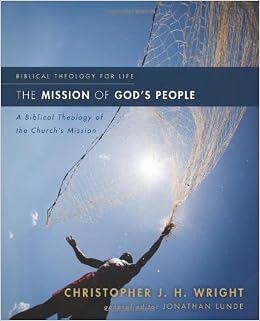
Leaders are Readers: The Mission of God's People

Harry S. Truman said, "Not all readers are leaders, but all leaders are readers."  This 'Leaders are Readers' series highlights books I read and my reflections on them to bolster my leadership learning as I serve students on campus.

Today's book is:  The Mission of God's People - by Christopher J. H. Wright

There was one thought that kept floating through my mind every time I picked up this book to read another section:  I wish my students would read this.

It would give great fodder for conversation around what the mission of God's people is, why we exist as an IV group on campus, and how those two things collide.

It was a great reminder of who we are called to be as God's people, and gave me a more thorough biblical look at our mission, beyond what I was taught in Sunday School as a kid.

Plus, as you read it you'd come across these great nuggets of truth that were packed with punch.  Like this one:

"When a whole community was called to know God, as Old Testament Israel was, it was a comprehensive social agenda, not just a badge of nominal national religion" (pg 151).

Wa-pow!

Here are some questions I'm reflecting on now that I've finished the read:
1) What would our InterVarsity chapter look like if students served and led from a place of God's mission as God's people, and not out of obligation, guilt, or fear?

2) How can I use the content and framework of this book to communicate the mission of God's people to my students?

Why I'd recommend it to you:
1) It's an academic read, but it doesn't read like an academic read.  It feels more conversational and logical as opposed to intellectual and stuffy.

2) I thought the sections gave helpful reflection questions for both individuals and groups.

3) It is thorough.  And I mean thorough.  It definitely feels like a textbook you would give out to a seminary class.

4) It gives a full, biblical exploration of the mission of God's people, not just the New Testament or one passage in the Bible.

What I'd be aware of:
1) It has TONS of side quotes and such.  I found them to be distracting although once in a while enlightening.  I skipped most of them because I hate having to read the main content and then go back to the side quotes or vice versa.


2) It took me a long time to finish reading.  Now granted, I'm a slow reader to begin with.  But, it confused me as to why it took me so long when it was a relatively easy read.  I definitely had a little celebration party for myself when I finally finished it.  Just a potential warning, I guess.

Friday, April 3, 2015

--From "The Living Reminder" by Henri J. M. Nouwen

The minister, as a living memory of God's great deeds in history, is called to heal by reminding people of their wounded past and by connecting their wounds with the wounds of all humanity, redeemed by the suffering of God in Christ.

But what are the implications of such a viewpoint for the personal life of the minister? 

The temptation is strong to ask the "how" question:  "How do I become a living memory of God; how do I accept and connect; how do I lift up the individual story into the divine history?"  These questions are temptations insofar as they avoid the more basic question:  "Who am I as a living memory of God?" 

The main question indeed is not a question of doing, but a question of being.  When we speak about the minister as a living reminder of God, we are not speaking about a technical specific tool, techniques, and skills, but about a way of being which embraces the totality of life:  working and resting, eating and drinking, praying and playing, acting and waiting.  Before any professional skill, we need a spirituality, a way of living in the spirit by which all we are and all we do becomes a form of reminding. 


One way to express this is to say that in order to be a living reminder of the Lord, we must walk in his presence as Abraham did.  To walk in the presence of the Lord means to move forward in life in such a way that all our desires, thoughts, and actions are constantly guided by him.  When we walk in the Lord's presence, everything we see, hear, touch, or taste reminds us of him.  This is what is meant by a prayerful life.  It is not a life in which we say many prayers, but a life in which nothing, absolutely nothing, is done, said, or understood independently of him who is the origin and purpose of our existence.

Thursday, January 8, 2015

Blessing to the nations.

I'm reading, The Mission of God's People:  A Biblical Theology of The Church's Mission, by Christopher J. H. Wright.

This is an excerpt from page 72:

Election is not the rejection of the rest, but ultimately for their benefit.  It is as if a group of trapped cave explorers choose one of their number to squeeze through a narrow flooded passage to get out to the surface and call for help.  The point of the choice is not so that she alone gets saved, but that she is able to bring help and equipment to ensure the rest get rescued.  "Election" in such a case is an instrumental choice of one for the sake of many.

In the same way, God's election of Israel is instrumental in God's mission for all nations.  Election needs to be seen as a doctrine of mission, not a calculus for the arithmetic of salvation.  If we are to speak of being chosen, of being among God's elect, it is to say that, like Abraham, we are chosen for the sake of God's plan that the nations of the world come to enjoy the blessing of Abraham (which is exactly how Paul describes the effect of God's redemption of Israel through Christ in Gal. 3:14).

Reading this book has been a slow-going process (because I read slow, not because of the content), but it's constantly reminding me of why I'm doing what I'm doing and all the things I'm trying to remind or instill in students at RIT.

Our mission is to be a blessing to the nations, not to bring comfort to ourselves.

Wednesday, November 5, 2014

Something for me and my students to reflect upon.

The spiritual life is not a life before, after, or beyond our everyday existence.  No, the spiritual life can only be real when it is lived in the midst of the pains and joys of the here and now.  Therefore we need to begin with a careful look at the way we think, speak, feel, and act from hour to hour, day to day, week to week, and year to year, in order to become more fully aware of our hunger for the Spirit.  As long as we have only a vague inner feeling of discontent with our present way of living, and only an indefinite desire for "things spiritual," our lives will continue to stagnate in a generalized melancholy.  We often say, "I am not very happy.  I am not content with the way my life is going.  I am not really joyful or peaceful, but I just don't know how things can be different, and I guess I have to be realistic and accept my life as it is."  It is this mood of resignation that prevents us from actively searching for the life of the Spirit.

Our first task is to dispel the vague, murky feeling of discontent and to look critically at how we are living our lives.  This requires honesty, courage, and trust.  We must honestly unmask and courageously confront our many self-deceptive games.  We must trust that our honesty and courage will lead us not to despair, but to a new heaven and a new earth. 

--from Making All Things New by Henri Nouwen

Tuesday, October 1, 2013

Counting the costs.

Believe it or not, InterVarsity staff workers, just like any missionary, can get discouraged.  And lately I've been discovering that when I am discouraged, it creates a vulnerable space where I pull out all the things I've sacrificed for this mission, list out each one before God, and complain to Him in this self-righteous, self-justifying tone, saying, "Look at everything I've given up to be here.  Why aren't things getting better?  Do you know how hard I'm working?"

It's terrible, I know.  But trust me, God's been pushing back.

There's a church that supports Nathan (which subsequently indirectly supports me) and hosts a missions weekend each year.  It's a whole affair where they work hard to invite all of the missionaries they support locally and globally together with the church to celebrate what God is doing.  It provides an opportunity for the church members to get to know the missionaries, learn about what God's doing through them, and for both church members and missionaries to encourage and exhort one another in roles we all have in Jesus' commission.  They have tons of food, activities, and even a whole flag ceremony.  Quite the shindig.

Well, it certainly was a notably encouraging experience for me.  People whom I had just met and barely knew wanted to talk to me and Nathan because they were curious about more specifics of what our job entailed or wanted to express genuine interest in praying for us specifically.  Others took the time to ask about what was going on and listen to the praises and struggles we were currently experiencing.  Still others went out of their way to make sure we knew that we could come to them for absolutely anything that we needed, whether it was specific prayer requests or ways to physically serve.  I felt so cared for and loved by these people who knew so little about me.  I was struck by the beauty of being connected through the body of Christ.

It was a message given by the keynote speaker for the weekend that particularly challenged me that weekend on a different note.  Norm Poehlke spoke about Matthew 13:44-46, which says:

"The kingdom of heaven is like treasure hidden in a field.  When a man found it, he hid it again, and then in his joy went and sold all he had and bought that field.  Again, the kingdom of heaven is like a merchant looking for fine pearls.  When he found one of great value, he went away and sold everything he had and bought it."

Norm unpacked verse 44, saying, "If finding treasure provokes a radical response and we have not made a radical response, then we have not found the treasure."  While this reminded me of the radical response I made in following Jesus to InterVarsity staff, it also reminded me that I found the treasure and that I needed to re-examine what that kingdom of heaven means to me now.

Then Norm continued, "So what's the pearl?  The Sunday School answer would be, 'Jesus,' right?"  We all chuckled.  "But that's not what the text says.  Jesus' death is not the pearl - it's the price he paid for the pearl."

It was as if God was saying to me, "I see everything you've given up.  I hear your cries and frustration.  But have you forgotten everything I've done for you?"

Finally, Norm left us with this challenge:  "Whose kingdom are we pursuing?  Are we saying, 'Jesus, come and sit on the throne of my life'?  Or are we answering Jesus' challenge to us to, 'Deny yourself, take up your cross, and follow me'?"

I think God has been saying, "Yes, Tammy, you've given up a lot of things to come and follow me.  But have you given up everything?  What are you still holding on to?"

Tuesday, October 16, 2012

"I Stand by the Door" - by Samuel Moor Shoemaker

I stand by the door. 
I neither go too far in, nor stay too far out,
The door is the most important door in the world-
It is the door through which people walk when they find God.
There's no use my going way inside, and staying there,
When so many are still outside and they, as much as I,
Crave to know where the door is.
And all that so many ever find
Is only the wall where a door ought to be.
They creep along the wall like blind people,
With outstretched, groping hands.
Feeling for a door, knowing there must be a door,
Yet they never find it ...
So I stand by the door.
The most tremendous thing in the world
Is for people to find that door--the door to God.
The most important thing any person can do
Is to take hold of one of those blind, groping hands,
And put it on the latch--the latch that only clicks
And opens to the person's own touch.
People die outside that door, as starving beggars die
On cold nights in cruel cities in the dead of winter—
Die for want of what is within their grasp.
They live, on the other side of it--live because they have not found it.
Nothing else matters compared to helping them find it,
And open it, and walk in, and find Him ...
So I stand by the door.
Go in, great saints, go all the way in--
Go way down into the cavernous cellars,
And way up into the spacious attics--
It is a vast roomy house, this house where God is.
Go into the deepest of hidden casements,
Of withdrawal, of silence, of sainthood.
Some must inhabit those inner rooms.
And know the depths and heights of God,
And call outside to the rest of us how wonderful it is.
Sometimes I take a deeper look in,
Sometimes venture in a little farther;
But my place seems closer to the opening ...
So I stand by the door.
There is another reason why I stand there.
Some people get part way in and become afraid
Lest God and the zeal of His house devour them
For God is so very great, and asks all of us.
And these people feel a cosmic claustrophobia,
And want to get out. "Let me out!" they cry,
And the people way inside only terrify, them more.
Somebody must be by the door to tell them that they are spoiled
For the old life, they have seen too much:
Once taste God, and nothing but God will do any more.
Somebody must be watching for the frightened
Who seek to sneak out just where they came in,
To tell them how much better it is inside.
The people too far in do not see how near these are
To leaving--preoccupied with the wonder of it all.
Somebody must watch for those who have entered the door,
But would like to run away. So for them, too,
I stand by the door.
I admire the people who go way in.
But I wish they would not forget how it was
Before they got in. Then they would be able to help
The people who have not, yet even found the door,
Or the people who want to run away again from God,
You can go in too deeply, and stay in too long,
And forget the people outside the door.
As for me, I shall take my old accustomed place,
Near enough to God to hear Him, and know He is there,
But not so far from people as not to hear them,
And remember they are there, too.
Where? Outside the door--
Thousands of them, millions of them.
But--more important for me--
One of them, two of them, ten of them,
Whose hands I am intended to put on the latch.
So I shall stand by the door and wait
For those who seek it.
"I had rather be a door-keeper ..."
So I stand by the door.
Sam Shoemaker, founder of Faith At Work at Calvary Episcopal Church in New York City in 1926, was also one of the spiritual leaders who helped draft the 12 Steps of Alcoholics Anonymous.